


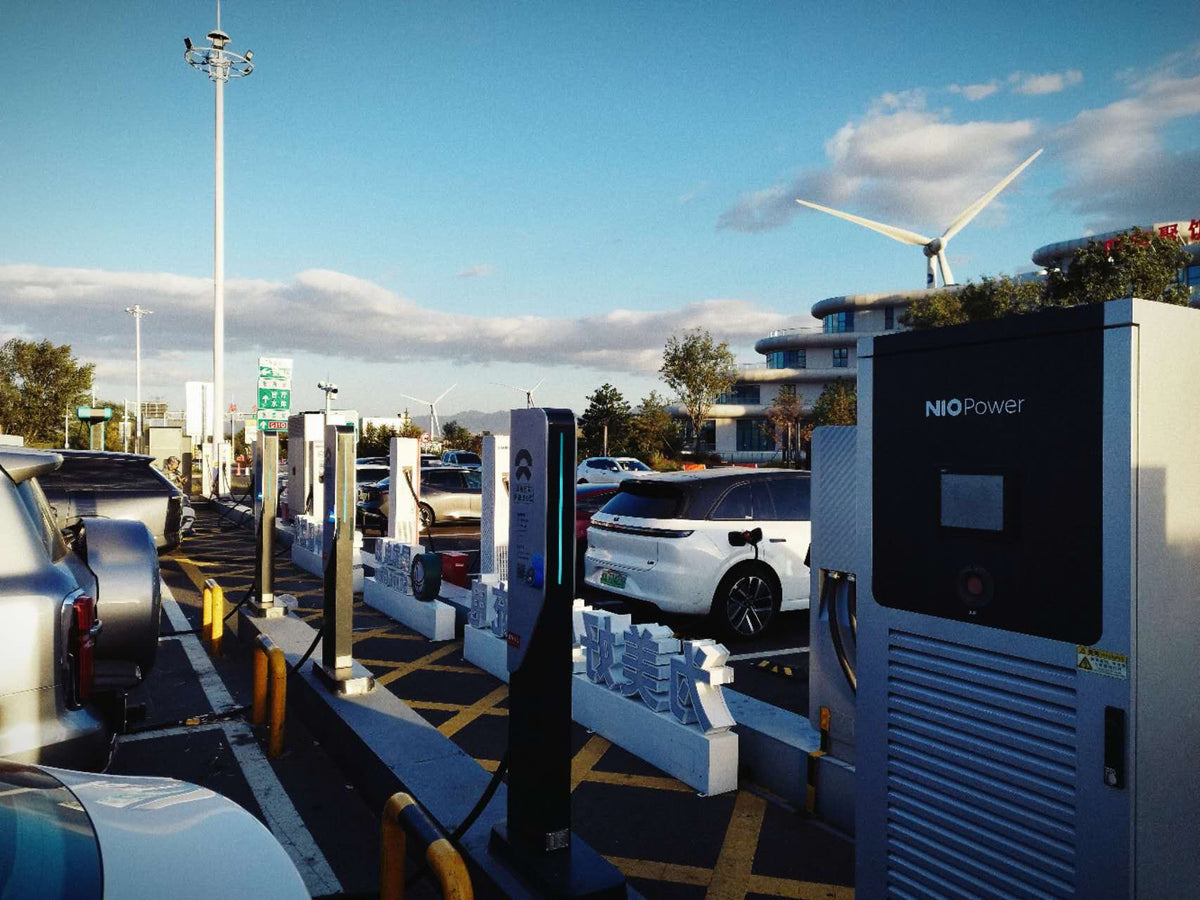
I’ve just returned from a two-week family trip to China, and as someone working in the EV charging industry in Australia, I naturally paid a lot of attention to how people charge their cars.
What surprised me most wasn’t simply the number of EV chargers in China.
It was how naturally EV charging has been integrated into the highway travel experience.
Along China’s highways, the highway service areas (服务区) are much more than somewhere to stop for fuel or use the bathroom. They have become convenient EV charging hubs, with multiple charging operators, plenty of charging bays, cafés, restaurants and other facilities all in one place.
For an EV driver, the experience can be remarkably easy.

Highway rest areas are becoming EV charging hubs
During our trip, I visited several highway rest areas, and two that particularly impressed me were the Luoyang service stop (Henan Province) and Guanting service stop (Hebei Province).
There were abundant EV charging bays, with a mixture of high-power DC fast chargers and 22kW AC chargers.
What I found particularly interesting was the variety of charging networks operating alongside each other.
Some chargers were operated by State Grid, while others were provided by private companies such as NIO, Huawei, BYD Flash Charging and TGOOD.
From a consumer's perspective, this means drivers have multiple charging options rather than relying on a single network.
And importantly, most of the equipment I saw appeared to be well maintained and operational. What was even more impressive was that, despite the already extensive charging infrastructure, new EV charging bays are still being built and added. In other words, China isn't simply catching up with the demand for EV charging—it appears to be continuously building ahead of it, anticipating that even more EVs will be on the road in the years to come.

The charging experience is integrated with the rest of the journey
Perhaps the biggest difference I noticed is that charging doesn't feel like a separate activity.
You arrive at the service area, plug in your car, and then do what you would normally do during a highway break.
Have a coffee.
Get something to eat.
Use the bathroom.
Stretch your legs.
Let the kids take a break.
By the time you're ready to continue your journey, the car may have gained a substantial amount of range.
And the coffee is surprisingly good.
Coffee for A$3 while your EV charges
Almost every highway service area we visited had convenient cafés or beverage shops.
I saw familiar Chinese chains such as Luckin Coffee, Cotti Coffee and Auntea Jenny, alongside other food and drink options.
For around RMB 15 (AUD 3), you can get a decent coffee, milk tea or fruit tea while your car is charging.
One small cultural tip for Australians travelling in China:
The default setting is often “sugar included”.
If you don't like sweet drinks, remember to specifically select no sugar (无糖) when ordering.
Otherwise, you may receive something considerably sweeter than your usual Australian coffee!
For EV drivers, however, this combination works extremely well:
Plug in → grab a coffee → take a break → return to a charged car → continue driving.
That is exactly what a good public charging experience should feel like.

The scale of Luoyang Longmen Grottoes was something else
The most impressive charging facility I saw wasn't actually on a highway.
It was at the Longmen Grottoes (洛阳龙门石窟) car park in Luoyang, a top tourist attraction in Henan Province.
I was genuinely surprised by the scale.
There were at least 300 EV charging bays.
That is, by far, the largest EV charging car park I have personally visited in any country.
Think about that for a moment.
Instead of having a handful of chargers tucked away at the edge of a car park, you can have an enormous parking area designed to accommodate EV charging at scale.
For a country with rapidly growing EV adoption, this kind of infrastructure demonstrates what becomes possible when charging capacity is planned alongside transportation and tourism infrastructure.
Different operators, one ecosystem
Another thing I found interesting was the coexistence of different charging operators.
I saw equipment from:
-
China State Grid
-
NIO
-
Huawei
-
BYD Flash Charging
-
TGOOD
-
and other local charging operators
From an Australian perspective, this is worth watching.
The EV charging market doesn't necessarily have to be dominated by one charging network. Multiple hardware providers, charging operators and energy companies can coexist within the same broader ecosystem.
The important thing for the driver is simple:
Is there a charger available when I need one, does it work, and can I conveniently pay for it?
Everything else is secondary.
What does this mean for Australia?
China's EV market is obviously very different from Australia's.
China has a much larger population, much higher EV sales volumes and a considerably larger domestic charging industry. We shouldn't assume that every aspect of the Chinese model can simply be copied in Australia.
But there are some lessons worth considering.
1. Charging should be part of the journey, not an inconvenience
A good charging station isn't just a charger.
It is a place where people naturally want to spend 20–40 minutes.
Coffee shops, restaurants, bathrooms, shopping and other amenities can turn charging time into useful break time.
2. Highway service areas are ideal charging locations
The existing highway rest-stop model provides an excellent foundation.
Drivers are already stopping there.
Adding substantial charging capacity simply makes the existing stop more useful for the EV era.
3. Different charging speeds have different purposes
I liked seeing both DC fast charging and 22kW AC charging.
Not every driver needs the fastest possible charger.
Someone stopping for a longer meal or rest may be perfectly happy with AC charging, while someone making a quick highway stop may prioritise DC fast charging.
A mature charging network should offer choices.
4. Scale matters
The 300+ charging bays at Longmen Grottoes really made an impression on me.
As EV adoption increases, we will eventually need to think beyond installing one or two chargers at a location.
Some destinations may need charging infrastructure designed for dozens or even hundreds of vehicles.

This article reflects my personal observations during a family trip through China and is not intended to be a comprehensive assessment of China's national EV charging infrastructure.
Share:
Tesla Hits 10,000,000 EVs: What This Milestone Means for EV Charging in Australia